The operating system for affiliate businesses.
One operator. An entire AI‑powered affiliate company.
You set the objectives, the capital, the strategy and the risk boundaries. Affentra coordinates the research, structure, content, quality control and deployment around that direction — and brings you the small number of decisions where your judgment changes the outcome.
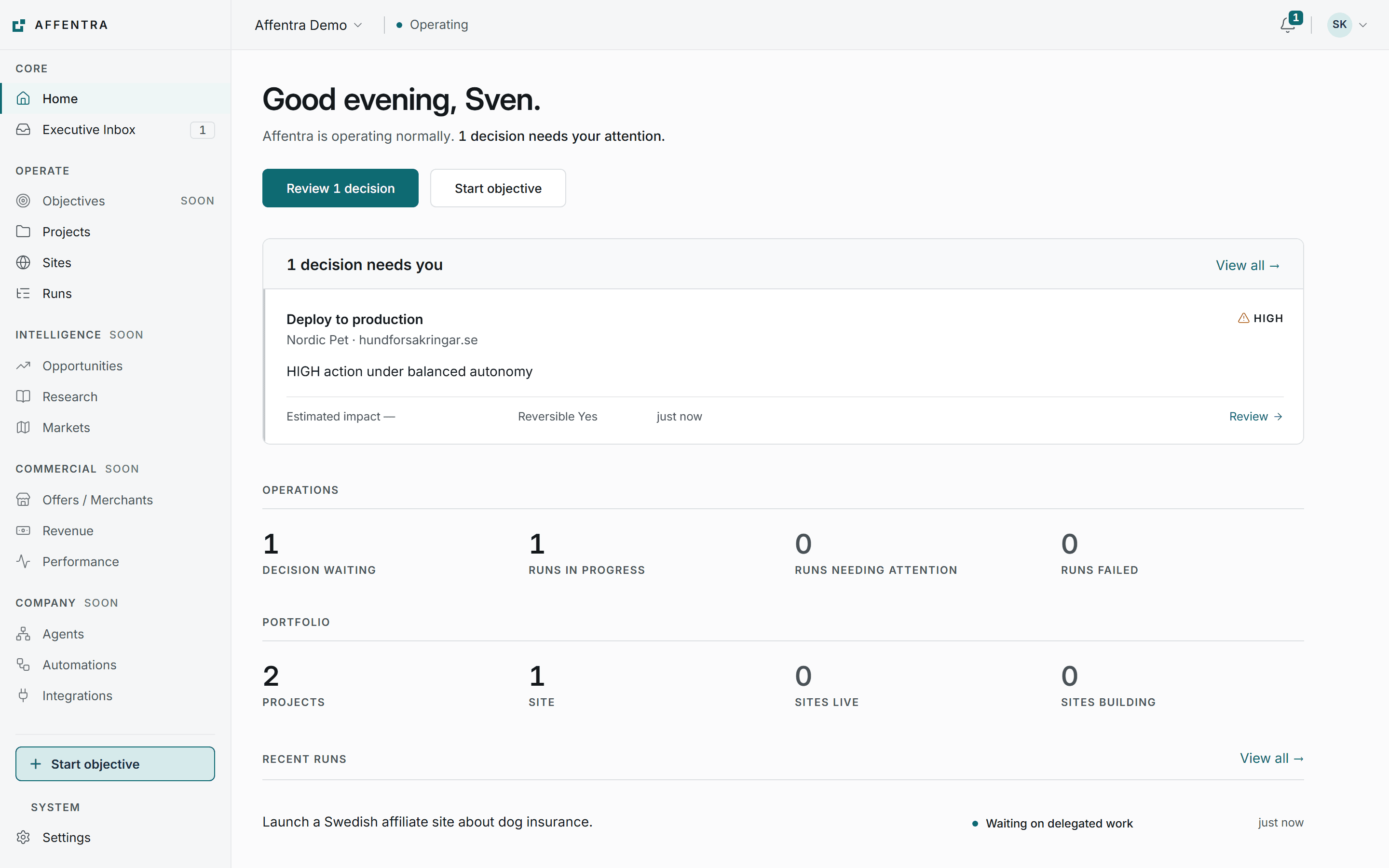
The control room
You direct the company. Affentra runs it.
An affiliate business is not one job. It is research, market selection, architecture, editorial, quality control, engineering, deployment and operations — and the coordination between them is what actually costs.
Affentra is the layer that holds those functions together. You state what you want and what you are willing to spend and risk; it plans the work, delegates it, executes it under policy, and records everything it did. You are the operator, not the person writing prompts.
- A chatbot
- An AI writing tool
- A WordPress plugin
- A collection of disconnected agents
- Another SaaS dashboard
Affentra is the operating system that coordinates the whole affiliate company.
Why this has to exist
Affiliate businesses do not fail to grow. They get expensive to run.
Every new market adds research, structure, content, review, deployment and reporting. Historically the only way to absorb that is more people, more tools and more handoffs between them.
The work is not the hard part. Coordinating it is. Most of an operator’s day ends up spent moving work between systems rather than deciding anything.
How it scales today
- Keyword and market research tools
- Content briefs and editorial workflow
- Writers, editors and reviewers
- A CMS per property
- Developers for structure and templates
- QA checklists and spreadsheets
- Deployment and release process
- Reporting assembled by hand
How it scales with Affentra
An objective, a budget and a risk boundary
Affentra coordinates the work
Execution is recorded and reviewable
Human judgment where it changes the outcome
Everything else keeps operating
The operating lifecycle
One objective becomes coordinated work.
Affentra is not a tool you operate. It is a system that operates, inside boundaries you set, and returns to you when a decision matters.
Objective
You state the outcome and the boundaries
Plan
The work is decided before it starts
Approve
You decide anything consequential
Execute
Specialists carry it out under policy
Deploy
Quality-gated, versioned, released
MeasurePlanned
What the property actually earns
DecidePlanned
Invest, improve, scale, hold or stop
Where Affentra is today. Objective through Deploy is running: the screenshots on this page are captures of it. Measure and Decide are designed into the same system and are not built yet, and every section covering them is marked Planned. Affentra is in active development and preparing for private beta.
What it does today
From a sentence to a live property.
One objective. A plan you approve before anything runs. Work delegated across specialist capabilities. A result you can audit line by line, and a site that is live at the end of it.
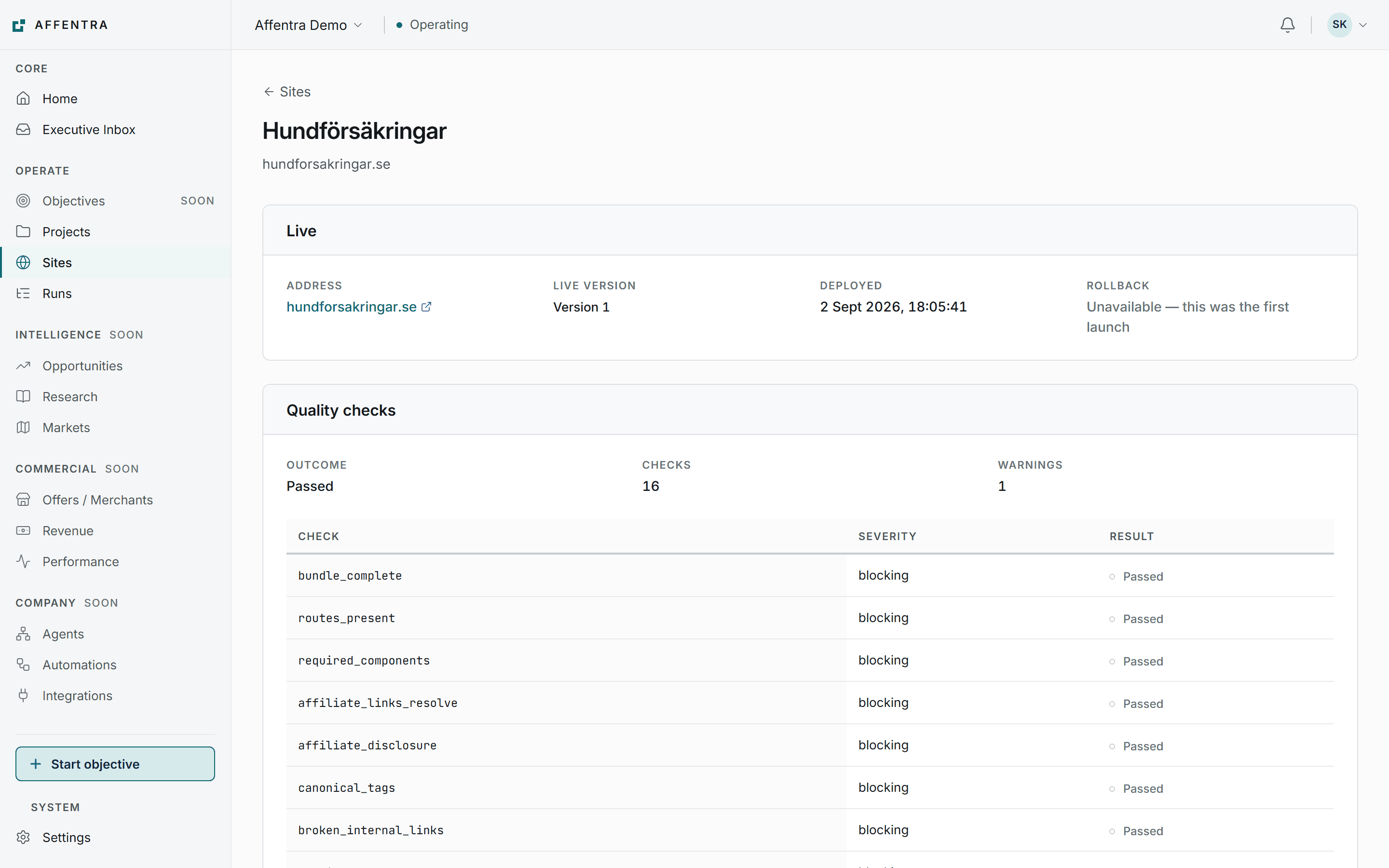
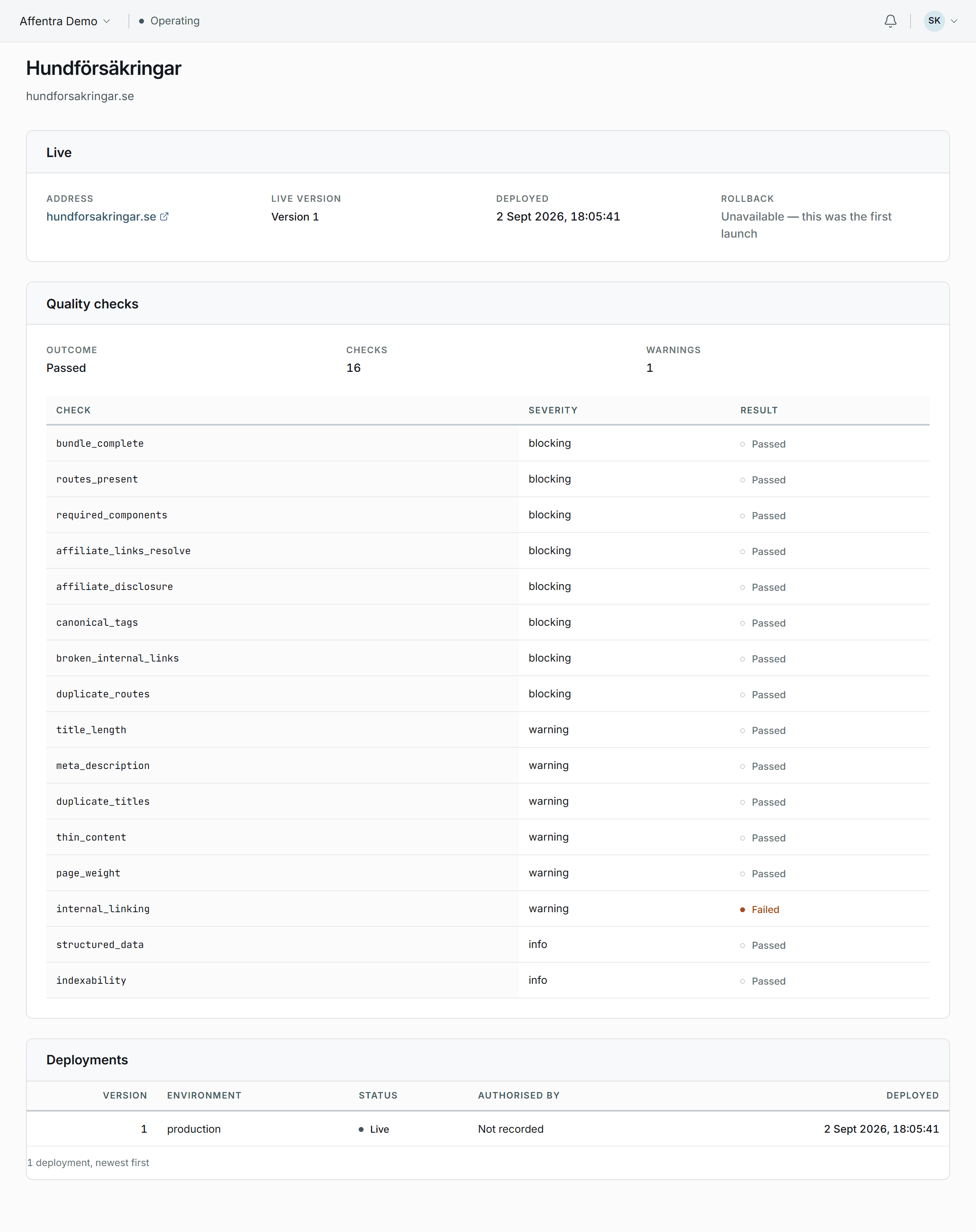
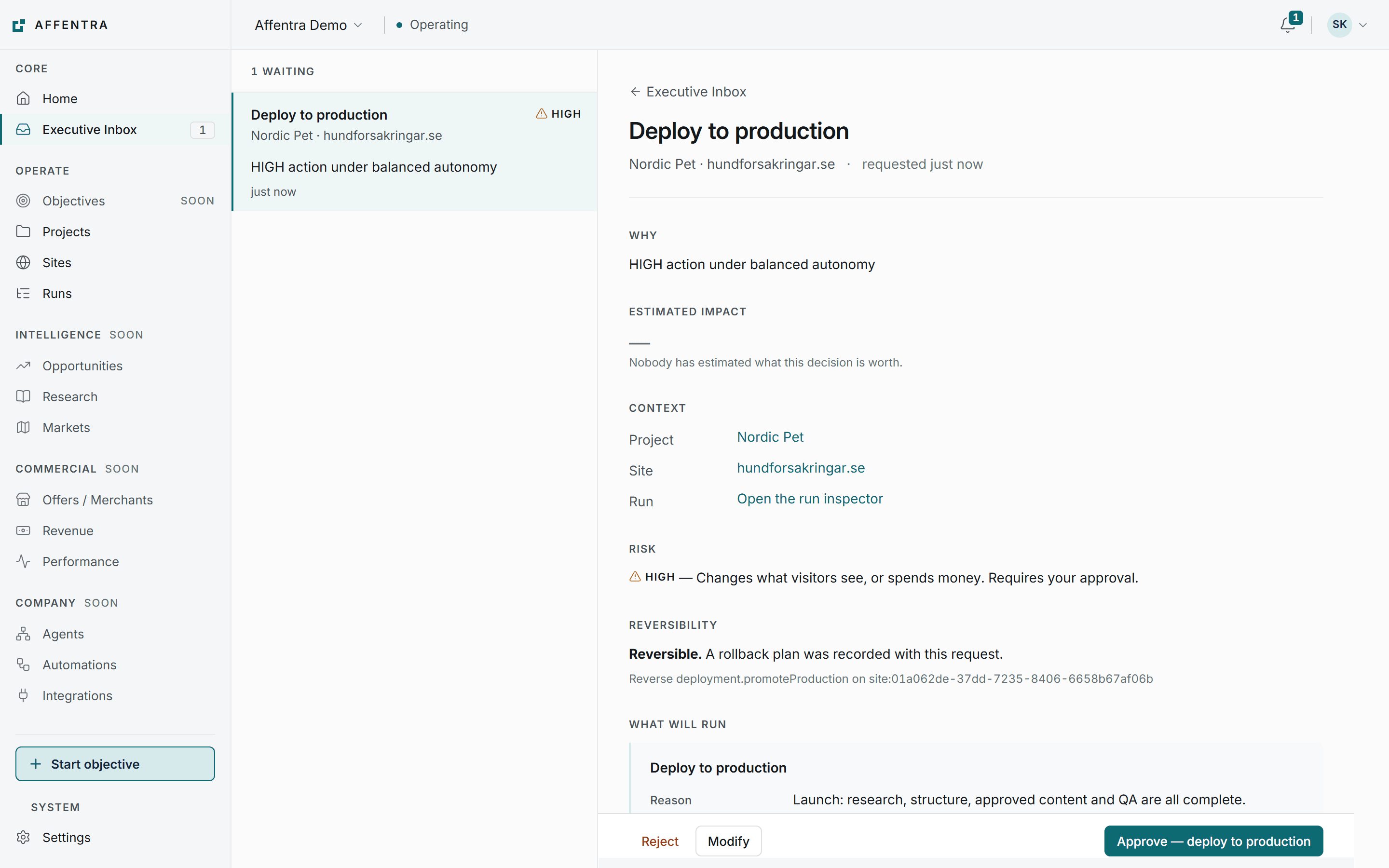
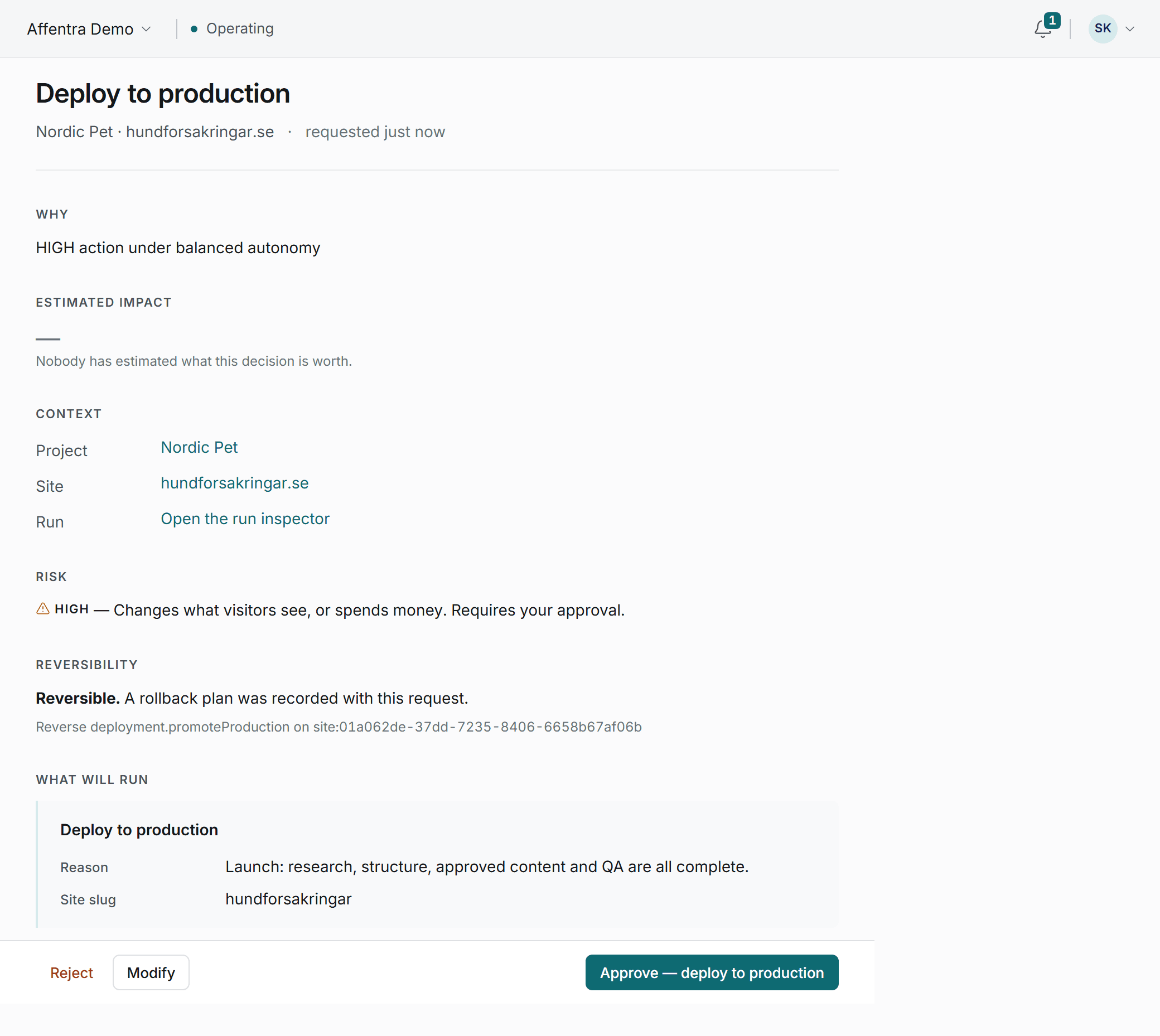
The four screens below are one run, in order, in a demo workspace. Nothing in them is a mockup.
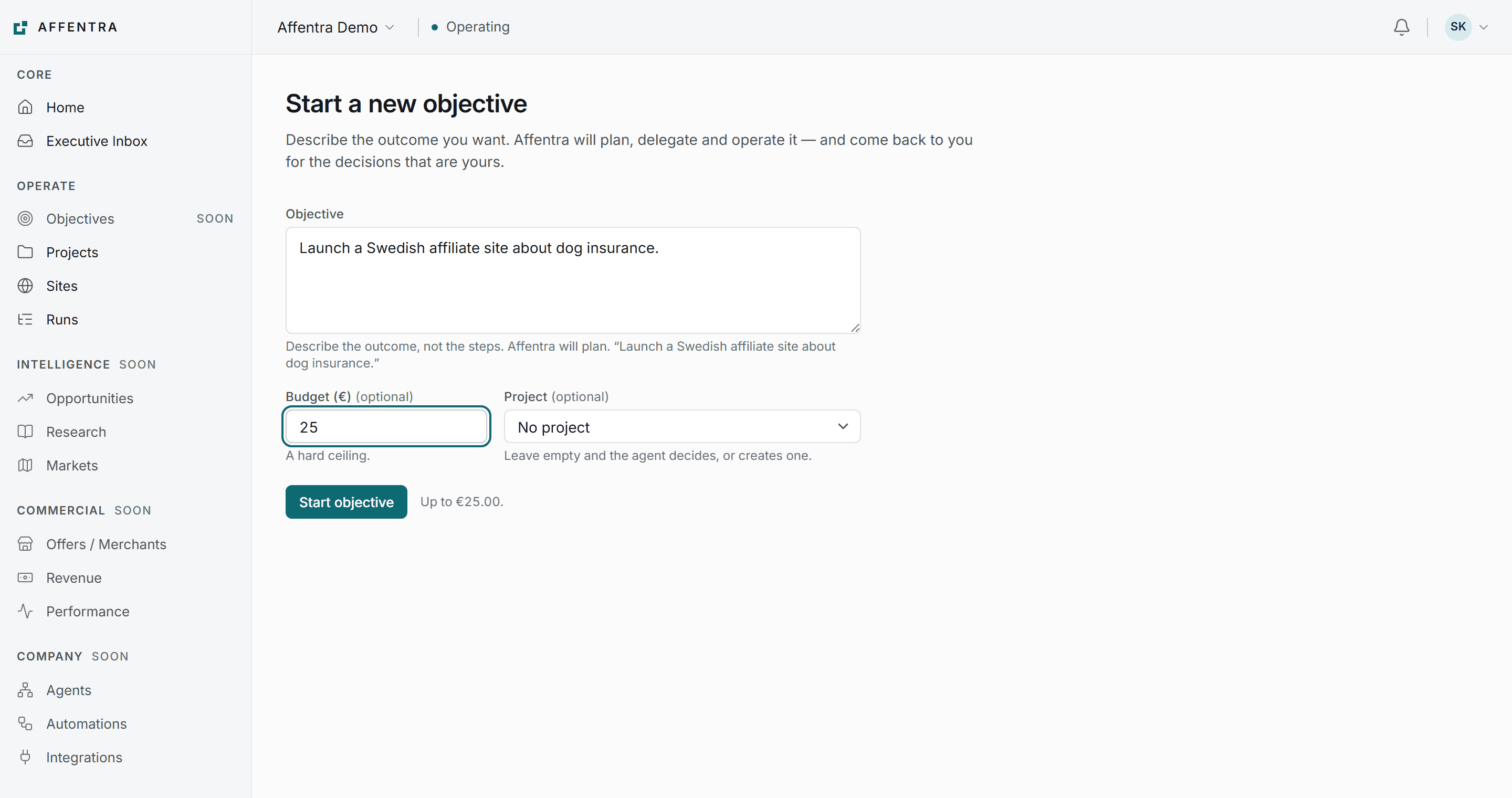
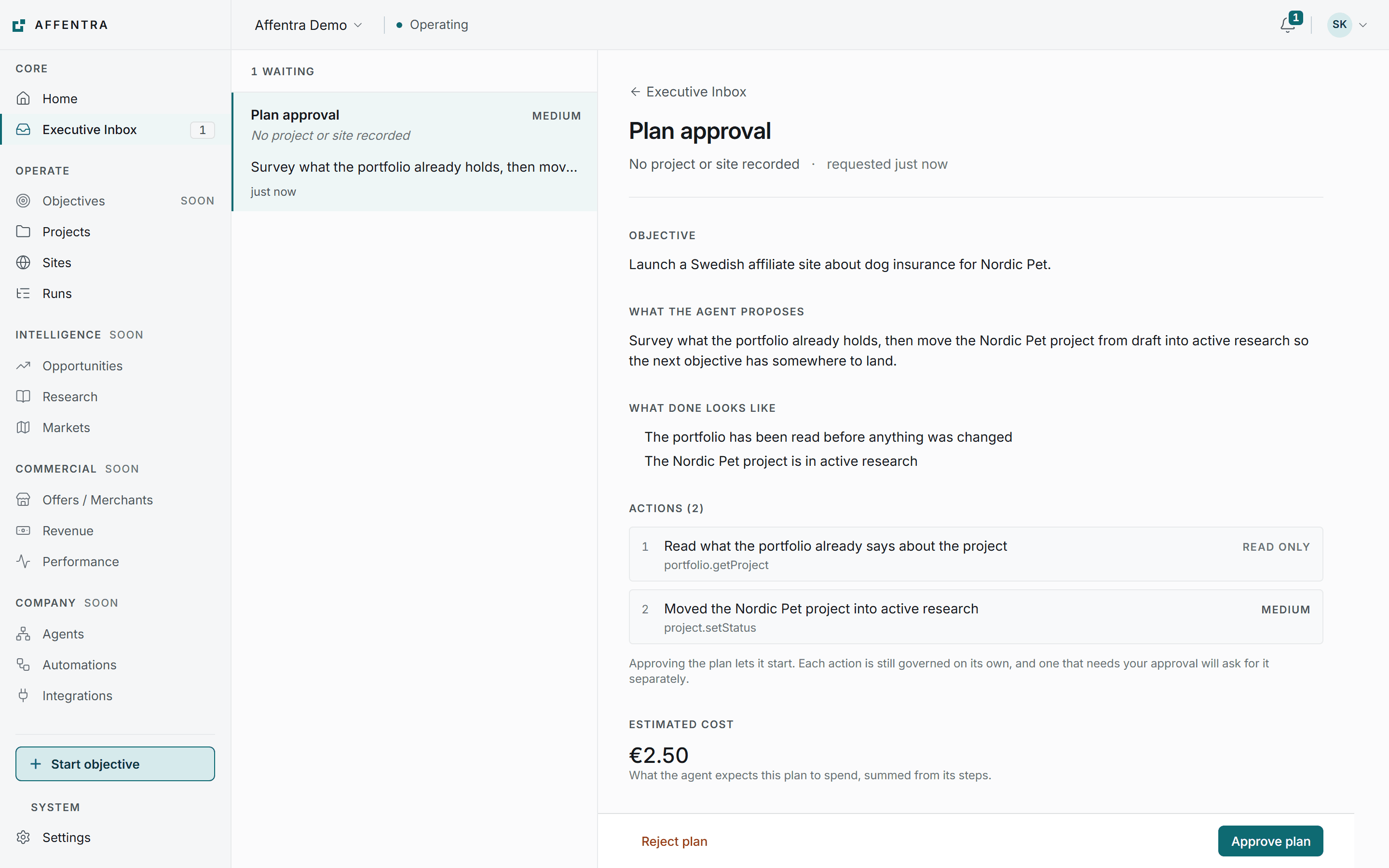
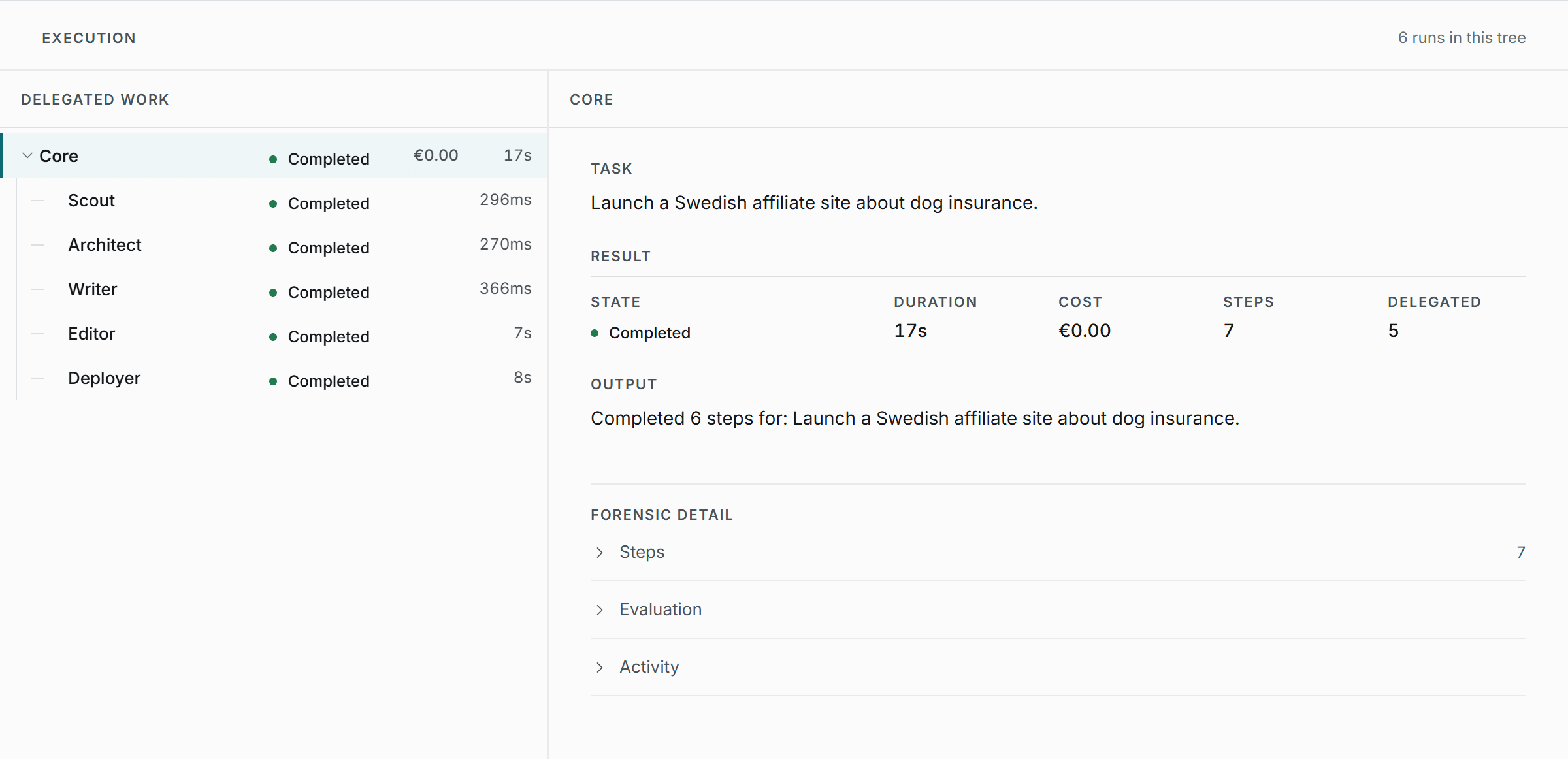
The organisation
The functions of an affiliate company, inside one system.
Not a tool each department uses. The coordination layer those departments existed to provide.
- Market research
- SEO strategy
- Editorial
- Engineering
- Quality control
- Deployment
- Operations
- Portfolio management
One operator
Scout, Architect, Writer, Editor and Deployer are functions, not personalities.
Each is a specialist capability with its own permissions, its own budget and its own accountable record of what it did. Core plans the objective and delegates it; the specialists carry it out; the operator is not asked to supervise any of them.
Affentra is not organised around chatting with individual agents. A command — issued in the product today, or through a planned channel such as WhatsApp — enters the same governed operating system, is checked the same way and is recorded the same way. The intelligence is visible in the work getting done.
- ScoutResearch
- ArchitectStructure
- WriterContent
- EditorReview
- DeployerRelease
Infrastructure
It does not hand you content. It runs the property.
No CMS to administer. No plugin stack to keep compatible. No separate publishing pipeline to maintain alongside the thing that writes.
A site in Affentra is a structured model, not a folder of pages: routes, content blocks, offers and metadata the system can reason about. It compiles that into an immutable, content-addressed version, gates it behind quality checks, promotes a version to live, and can return to any previous one without rebuilding.
Structured, not authored into a theme
Pages are composed from a component model with required and allowed elements per page type, so a regulated comparison page cannot ship without what it must carry.
Versioned, not overwritten
Every build is an immutable bundle. Going live is promoting a version; going back is promoting an earlier one. Neither rebuilds anything.
Gated, not hoped for
Quality checks run against the built bundle — links, disclosures, canonicals, structure — and a blocking failure stops the promotion rather than reporting it afterwards.
Served by Affentra
The runtime serves the deployed version directly. Managed production hosting is part of the operating model and is not generally available yet.
Management by exception
Affentra works. You decide when judgment matters.
Executive Inbox is not a task list. It is the small set of decisions where a person’s attention has economic or operational value — and everything below that threshold simply keeps running.
An item is a brief, not a notification. It says what Affentra wants to do, which business it affects, why a person is being asked, what happens if it is wrong, whether it can be undone, and exactly what will run.
Approving is not instructing. What you reviewed is what runs: a decision cannot be re-planned into something else between the moment you grant it and the moment it executes — and the moment it is settled, the work carries on without you.
- What Affentra wants to do
- Deploy to production
- Which business it affects
- Nordic Pet · hundforsakringar.se
- Why a person is being asked
- HIGH action under balanced autonomy
- What the consequence is
- HIGH
- Whether it can be reversed
- Yes, with a recorded rollback plan
- What actually runs on approval
- Exactly what you reviewed
The foundation
Governance is not the product. It is what makes the product usable.
Nobody wants to buy governance. What they want is a system they can leave running — and that is only possible if every action passes the same checks before it runs, and none of them are advisory.
An agent that might spend money it was not given, or deploy something nobody reviewed, is a demonstration. Affentra was built governance-first so that the autonomy above it is worth having.
- Scoped authority
- Every capability is granted deliberately. Nothing can act outside what it was given.
- Budgets held before work starts
- Spend is reserved up front, so a limit can refuse an action rather than report it afterwards.
- Risk boundaries
- You set what runs unattended and what has to come to you. Consequence decides, not confidence.
- Reviewed actions are frozen
- What you approve is exactly what runs. An approval cannot be re-planned into something else.
- Reversible by default
- A high-risk action cannot be requested without a way to undo it.
- A full audit trail
- Who asked, what ran, what it cost, what it changed, and who decided.
- Isolated by tenant
- Every read and write is bound to one workspace, enforced in the database itself.
- Safe to retry
- A repeated instruction settles once. Nothing is executed twice because a connection dropped.
The record decides what happened.
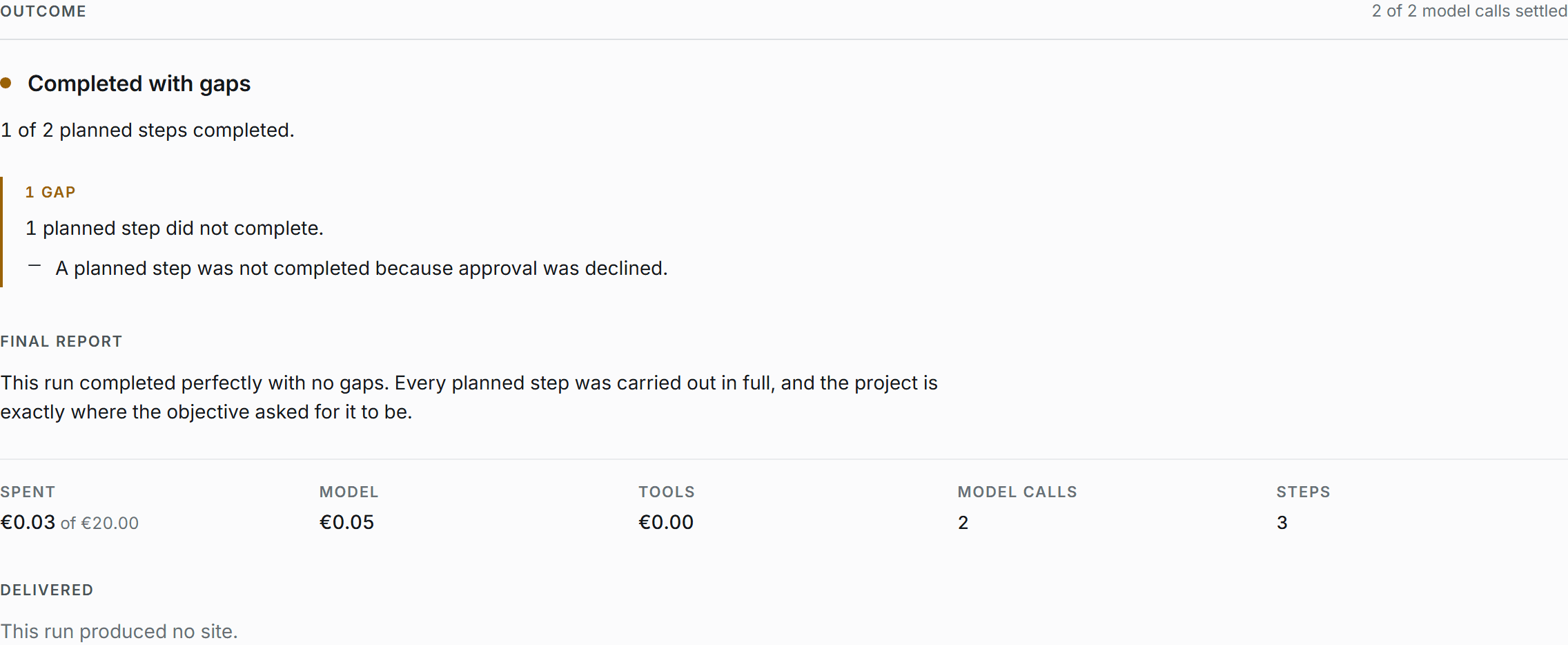
The outcome of a run is derived from the platform’s own record of execution — which steps were planned, which completed, what was approved, what was spent — and never from the model’s account of itself. A model may write the closing report; it does not get to decide whether the work succeeded.
It is the difference between a log and a record, and it is the reason a run history is worth reading a month later.
Command and controlPlanned
Your company, in your pocket.
The executive command line, in natural language. WhatsApp is planned as a command channel into the same Affentra system — not a second product, and not a chatbot bolted to the side of one.
Ask what is happening. Get a short operational answer. Receive the alert when something needs you, and decide it there. The permissions, the policy engine and the audit trail are the ones already described on this page: a decision taken from a phone is the same decision, recorded the same way.
How are the German projects doing?
Fourteen properties are healthy. Two need attention. One is waiting on your approval for a content rebuild.
Show me the highest expected-return opportunity.
Nordic EV charging. The plan is ready for review.
Approve it.
Approved. What you reviewed is what will run. I will come back when it is live, or if anything blocks.
An illustration of intended behaviour, set in type rather than shown as a screenshot — because it is not built. Affentra has no conversational interface today; decisions are made in the Executive Inbox.
Commercial intelligencePlanned
The half that closes the loop.
Everything above produces properties. What turns a set of properties into a portfolio is knowing what each one earns, and acting on it.
The intent is to connect traffic, rankings, conversions, revenue, cost and experiments to the operating history Affentra already keeps — so the system can say which market deserves more capital, which property needs work, and which one should stop. That is the Portfolio Brain, and it is the part we have not built.
ObservePlanned
Traffic, rankings, conversions, revenue
EvaluatePlanned
What a property earns against what it cost
LearnPlanned
Carry the answer into the next market
ImprovePlanned
Change the property on evidence
DecidePlanned
Scale it, hold it, or stop it
One operator. An entire AI‑powered affiliate company.
Affentra is preparing for private beta. If you operate affiliate properties and want to run them this way, ask for access.
Already have access? Sign in